
In summary
Lime screed with RC Calcifix offers a durable alternative to traditional cement screed, delivering comparable strength with major added benefits:
Ecological advantages: Natural hydraulic lime (NHL) is fired at 900 °C versus 1450 °C for cement, resulting in lower CO₂ emissions. NHL also reabsorbs CO₂ during carbonation.
Building-physics benefits: More elastic (fewer cracks), more vapour-open (better moisture regulation), salt-resistant (no sulphate decay) and compatible with historic buildings.
Performance: Independent tests by Buildwise and SGS Intron show similar compressive and flexural strength to cement, with better abrasion resistance and minimal shrinkage.
Application: Walkable after 3 days, ready for tiling after 7 days using vapour-open adhesive (KHOLAO COLLE). Consumption: 250 kg/m³. Ideal for underfloor heating, renovation and natural-material construction.
Conclusion: For long-term durability, a healthy indoor climate and sustainable building, lime screed is the smart choice.
For decades, the traditional cement screed has been the standard in residential and commercial buildings. Yet, interest is growing in an age-old building material: lime screed.Thanks to the renewed focus on sustainability and healthy indoor environments, natural hydraulic lime (NHL) is once again in the spotlight.
Cement Screed: Strong but Environmentally Burdensome
Cement-based screeds are known for their high strength, fast curing, and easy application—making them popular among contractors and floor installers.However, several disadvantages are associated with cement:
- Cement screed is less ecological and less sustainable than lime screed. The production of Portland cement requires significantly more energy and generates higher CO₂ emissions than the production of natural hydraulic lime (NHL).Lime is fired at around 900°C, while cement clinker requires about 1450°C. Moreover, NHL lime reabsorbs CO₂ during curing (carbonation).
- Cement screed is far less flexible than lime screed. Its rigidity makes it more prone to cracking in cases of settlement, vibration, or temperature changes.Lime, with comparable compressive and tensile strength, provides elasticity to the mortar, allowing minor movements to be absorbed without cracking. This results in a healthier indoor climate and improves the durability of surface finishes.
- Cement screed is much less vapour-permeable than lime screed. In cases of rising damp, this can cause rapid deterioration of the screed and lead to moisture migrating into walls, resulting in flaking paint, plaster damage, and mould growth. Lime, by contrast, allows vapour to pass through, enabling moisture to evaporate naturally.
- Cement screed is more sensitive to salts than lime screed. Cement contains calcium hydroxide (Ca(OH)₂) and aluminates, which can react chemically with salts present in soil moisture or clay bricks. Sulphates, in particular, can trigger ettringite formation, causing expansion (sulphate attack) and internal stress, eventually leading to cracking, delamination, and disintegration. Saint-Astier’s natural hydraulic lime contains virtually no reactive aluminates and does not react with sulphates. Its breathable nature also allows salts such as nitrates and chlorides to migrate toward the surface and crystallize externally, preventing internal pressure and damage.
- Cement screed is incompatible with historic buildings, while lime screed is not. Because cement screed is harder and denser than traditional materials like brick, natural stone, or lime mortar, stresses can occur at junctions between floors and walls. This often leads to cracks, detachment of plaster, or even structural damage. Lime screed, on the other hand, is both physically and chemically compatible with historic materials.
Lime Screed: Breathable and Ecological
While cement screeds remain common due to their quick curing and high compressive strength, they pose significant risks in damp or heritage contexts. Lime screeds, made with a binder based on natural hydraulic lime (NHL), provide a sustainable and physically balanced alternative. They combine high compressive and flexural strength with vapour-permeable and moisture-regulating properties, allowing moisture and salts to be naturally expelled. The result: a more stable floor, reduced cracking, a healthier indoor environment, and a considerably longer lifespan for both floor and building.
Technical Comparison: Lime Screed vs. Cement Screed
The following values are based on test reports from Buildwise (DE-BE-0180 / DE-SW-0037, 2024) and SGS Intron (report 243503). These independent tests confirm that ecological lime screeds using RC Calcifix perform fully on par with traditional cement-based systems — offering additional advantages in durability, moisture resistance, salt resistance, shrinkage behaviour, and abrasion resistance.
Practical Application
Cement screeds are appreciated for their rapid application and familiarity in the construction sector.
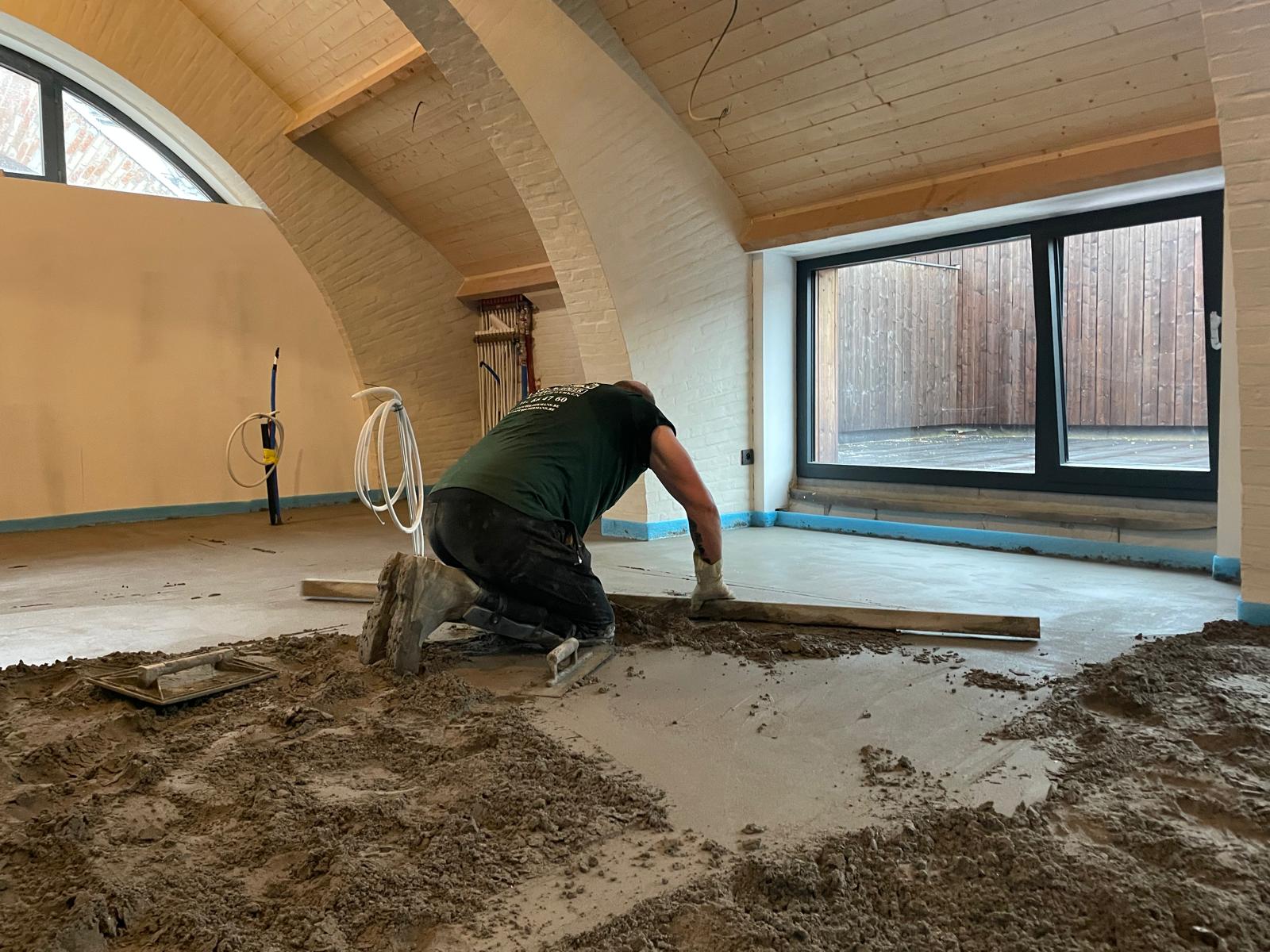
However, lime screeds with RC Calcifix are now equally practical thanks to their optimized formulation. The mortar can be applied using standard screed pumps and tools. After levelling and smoothing, the screed is walkable after approximately three days. When using vapour-permeable adhesives (e.g. KHOLAO COLLE) and grout (e.g. KHOLAO JOINT), tiling can begin after seven days.
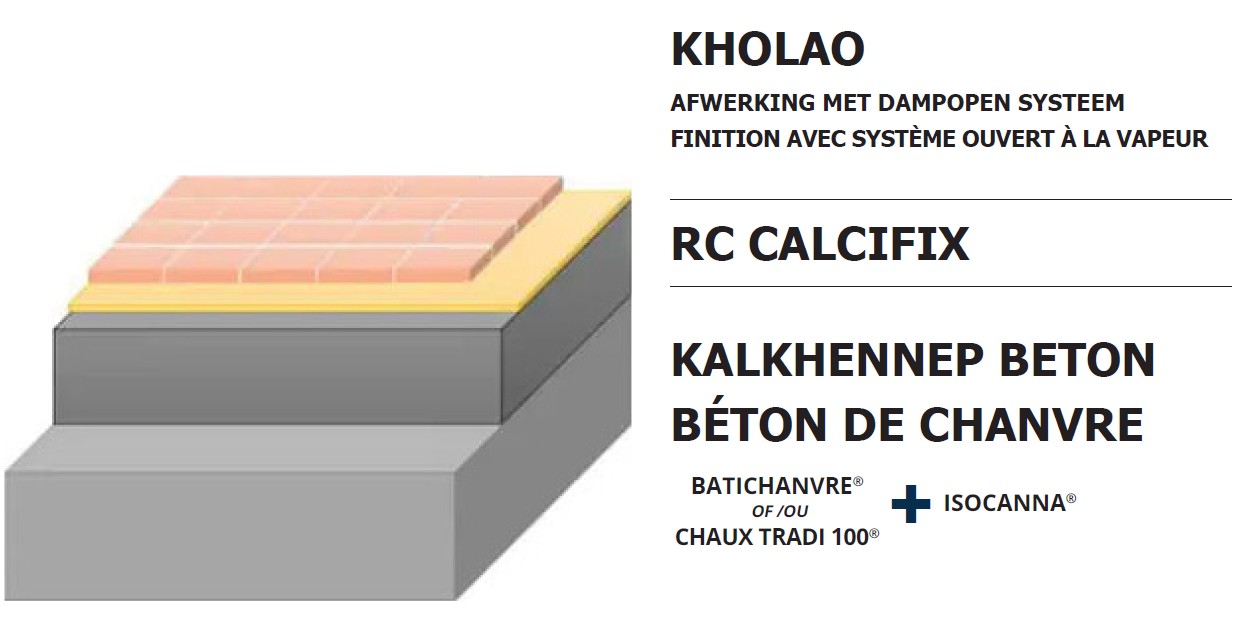
The extended final curing period (60–90 days) occurs without noticeable shrinkage or stress, reducing the risk of cracking or curling. This makes lime screeds particularly suitable for underfloor heating and renovations on sensitive substrates.
Consumption figures
- Cement screed: 250–350 kg cement binder/m³
- RC Calcifix: 250 kg lime binder/m³
The lower binder consumption translates to reduced raw material and energy use per square meter of floor — directly contributing to the ecological benefits of the system.
Applications and Added Value
Lime screeds prove their worth in both renovation and restoration projects as well as modern ecological new builds. Thanks to their breathable nature, they are ideal for projects where moisture regulation, compatibility with natural materials, and sustainability are priorities.
Their low shrinkage, good thermal conductivity, and natural moisture buffering also make them an excellent choice in combination with underfloor heating or bio-based insulation materials such as hemp-lime.
A Matter of Choice
While cement screeds remain suitable for projects where speed and early strength are key—such as industrial floors or fast-track construction—lime screed with RC Calcifix offers clear advantages for those thinking long-term.
It contributes to comfort, durability, and energy efficiency, perfectly aligning with the shift toward a circular building economy where materials are reusable, healthy, and environmentally responsible.
.avif)

