In summary
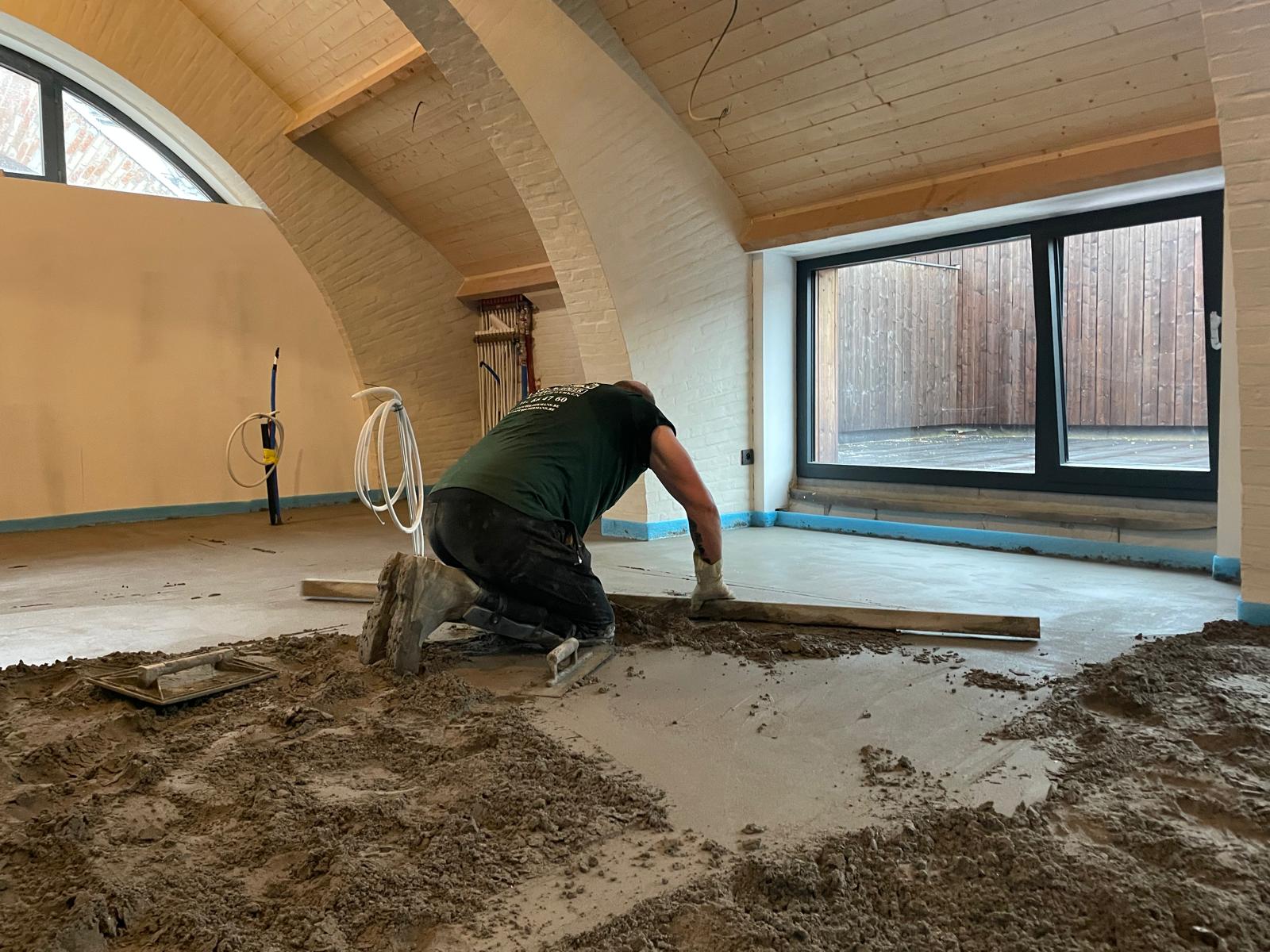
Lime concrete — also known as a vapour-open concrete floor, hydraulic lime floor or lime-bound screed — is a structural floor assembly based on natural hydraulic lime (NHL 5), sand and mineral aggregates. Unlike conventional cement floors, the material remains vapour-permeable, allowing moisture to migrate in a controlled manner without accumulating within the construction. This makes lime concrete particularly suitable for renovations without a waterproof barrier, heritage projects and bio-ecological new builds. Thanks to its lower stiffness, good compatibility with historic materials and reduced CO₂ impact, it offers a durable alternative to traditional concrete floors. Combined with a fully vapour-open system (such as RC CALCIFIX lime screed and KHOLAO finishing products), the result is a breathable floor assembly that remains both technically stable and building-physically sound.
What is lime concrete?
Lime concrete is a vapour-open, lime-bound concrete floor based on natural hydraulic lime (NHL 5, in accordance with EN 459-1), mineral aggregates and water, used as a structural floor slab in renovation, heritage and bio-ecological construction. Optionally, pozzolans, polypropylene fibres or other mineral admixtures may be added.
The distinction from cement concrete lies in the type of binder: NHL hardens through hydraulic reaction and carbonation, during which the material reabsorbs CO₂ from the air. As a result, the floor remains vapour-permeable, its strength continues to increase as carbonation progresses, and the material is compatible with historic substrates.
Why choose lime concrete?
Lime concrete offers a number of advantages, particularly in renovation projects and in buildings where compatibility with the building’s structural integrity is important.
Vapour-open and moisture-regulating
Lime concrete is naturally vapour-permeable (µ-value significantly lower than cement concrete). Moisture can migrate as vapour without accumulating within the floor assembly. This makes the material particularly suited to:
- Renovations without a waterproof membrane beneath the floor
- Historic buildings with brick foundations or earth substrates
- Floor assemblies incorporating hemp-lime, foam glass or other hygroscopic insulation materials
A conventional PE membrane or cement-bound floor interrupts this vapour flow and, where waterproofing is incomplete, can lead to damage: rising damp, salt efflorescence and deterioration of finish layers.
Lower ecological impact
NHL 5 is fired at lower temperatures than Portland cement (approximately 900–1,000°C versus 1,450°C), resulting in significantly lower primary energy consumption and process-related CO₂ emissions. Through carbonation, lime also reabsorbs a portion of the CO₂ emitted during production over the course of the hardening period.
Reduced risk of cracking
Lime concrete has a lower modulus of elasticity than cement concrete. It can therefore accommodate small stresses and shrinkage without developing through-cracks, provided the curing process is carried out correctly and movement joints are installed.
Compatible with historic materials
Lime concrete is building-physically compatible with historic materials such as brick, natural stone and traditional lime mortars, as well as with natural insulation materials such as hemp-lime or foam glass. This makes it a particularly suitable solution for heritage and renovation projects where stress concentrations between old and new materials must be avoided.
Roman concrete as inspiration
The term Roman concrete (opus caementicium) refers to the lime-bound construction method used by the Romans in combination with volcanic pozzolan (pozzolana) from the region around Naples and Pozzuoli. The resulting bond — formed by the reaction of lime with amorphous silica in the ash — produced a hydraulic and durable material capable of hardening even under water. Well-known examples include the Pantheon in Rome and various ancient harbour structures.
Modern lime concrete systems with NHL 5 and optional pozzolan addition represent a contemporary application of the same binding principle. They are not a direct reproduction, but draw on the same hydraulic reaction between lime and reactive siliceous compounds.
The modern technical basis
A contemporary NHL floor is built around three core components: NHL 5 as the binder, siliceous or silico-calcareous aggregates 0/36 mm as the skeleton, and water for workability.
Mix proportions per m³ of finished lime concrete:
Depending on the application, functional admixtures may be incorporated: pozzolans to strengthen the hydraulic bond and improve early compressive strength; polypropylene fibres to limit plastic shrinkage cracking during the early hardening phase; and/or mineral fillers for volume stability and workability.
Technical performance for an interior lime concrete floor (NHL 5 – 0/36 mm aggregates):
- Compressive strength at 28 days: ~3–4 MPa
- Compressive strength at 90 days: >6 MPa (continues to increase through carbonation)
- Minimum thickness: 15 cm
- For assemblies exceeding 25 cm: place in layers of 10–15 cm with a maximum interval of 48 hours between layers
Metal reinforcement or welded steel mesh is not permitted. The low pH of lime concrete prevents the passivation of steel, leading to corrosion and structural degradation.
Movement joints are mandatory to accommodate stress build-up in a controlled manner: maximum 25 m² per bay, maximum spacing of 6 m, joint depth of 1/4 to 1/3 of the slab thickness, joint width 3–5 mm.
Curing is critical for correct hardening. After casting: keep the space closed, lightly mist the floor 1–2 times per day for two weeks, and cover with sheeting if necessary. Protect against frost, direct sunlight and drying winds.
Finishing lime concrete
The building-physical advantages of lime concrete are only fully realised when the overlying layers are also vapour-permeable. A sealed finish layer — tiles on cement adhesive, PVC or epoxy — interrupts the vapour migration path and nullifies the moisture-regulating effect of the lime-bound slab.
A correctly constructed breathable floor assembly functions from bottom to top as one integrated system:
- Lime concrete (NHL 5, min. 15 cm) as the structural, vapour-open base layer
- Hemp-lime mortar as an insulating or build-up intermediate layer with thermal and hygroscopic buffering (optional, depending on build-up height and insulation requirements)
- RC CALCIFIX lime screed as a flat, stable and vapour-open substrate for the floor covering
- KHOLAO COLLE as a vapour-open tile adhesive for bonding ceramic or natural stone floor coverings
- KHOLAO JOINT as a vapour-open grout for finishing the joint spaces
Every layer in this system is mineral, lime-bound and vapour-permeable. Moisture can migrate in a controlled manner throughout the entire floor assembly without accumulation, condensation or structural damage.
This makes the combination of lime concrete + RC CALCIFIX + KHOLAO system particularly well-suited to renovations of farmhouses and historic properties, heritage restoration and bio-ecological new builds — wherever a breathable floor assembly with natural materials is the building-physical requirement.
Conclusion
While traditional concrete floors are mainly chosen for their speed of application and high initial strength, lime concrete offers clear advantages in projects where durability, moisture management and compatibility are key priorities.
It combines a structural base with a breathable build-up, making it particularly suitable for renovation and restoration projects. For those looking for a floor system that takes building physics and ecology into account, lime concrete is a highly interesting alternative to traditional concrete floors.
.avif)